![[AUTO] GSLV Mk II - image](/media?u=https%3A%2F%2Fthespacedevs-prod.nyc3.digitaloceanspaces.com%2Fmedia%2Fimages%2Fgslv2520mk2520ii_image_20190825171642.jpg&w=1600)
Indian Space Research OrganizationGSLV Mk. IISatish Dhawan Space Centre Second Launch Pad, Satish Dhawan Space Centre, India
NISAR (NASA-ISRO Synthetic Aperture Radar)
Launched
July 30, 2025 · 12:10 UTC
Summary
NISAR (NASA-ISRO Synthetic Aperture Radar) launched on an Indian Space Research Organization GSLV Mk. II from Satish Dhawan Space Centre Second Launch Pad, Satish Dhawan Space Centre, India on July 30, 2025 at 12:10 UTC. It was Indian Space Research Organization's 96th launch, 3rd this year and humanity's 7,017th orbital launch attempt. It was the 12th GSLV Mk. II flight and the 2nd this year. The payload was bound for Sun-Synchronous Orbit (SSO). NISAR, one of 2 catalogued objects, reached a 741 × 757 km orbit inclined 98.4°. 2 objects from this launch are catalogued, one of them a payload.
- Watch
- Booster
- No booster details on record.
- Mission
- Earth Science · Sun-Synchronous Orbit (SSO)for ISRO, JPL, NASA
- Milestone
- 12th GSLV Mk. II flight · 2nd this yearIndian Space Research Organization's 96th launch3rd this yearhumanity's 7,017th orbital launch attempt168th orbital launch attempt this year
Webcast
Flight preview
Orbit: as tracked
NISAR · NORAD 65053 · 2025-163 · Space-Track · tracking 1 of 2 objects
Show the numbers for orbit elements
- Object
- TBA - TO BE ASSIGNED
- Object ID
- 2025-164A
- Epoch
- 2025-07-30 13:39:46 UTC
- Mean motion
- 14.44992536 rev/day
- Eccentricity
- 0.0010824
- Inclination
- 98.4322°
- Ascending node
- 38.4407°
- Arg. of perigee
- 289.3524°
- Mean anomaly
- 166.629°
- Element set
- 999
- Rev at epoch
- 0
- B*
- 0
Perigee, apogee and period are Kepler figures from the catalogued mean elements, not a propagated state. Published orbit: SSO. Ascent drawn from padside's representative profile.
Flight timeline
- T−5SIgnition
- T−0Liftoff
- T+2M29SMECO
- T+2M30SSES
- T+2M31SStage 2 Separation
- T+2M51SFairing Separation
- T+4M50SSECO
- T+4M53SStage 3 Separation
- T+4M54SStage 3 Ignition
- T+18M21SStage 3 Cutoff
- T+18M36SPayload Separation
Catalogued objects
2 catalogued: 1 payload, 1 rocket stage; 2 still in orbit
- NISAR · NORAD 65053 · in orbit
GSLV CUS-14? · in orbit
Data from J. McDowell, planet4589.org
About this launch
The NASA-ISRO Synthetic Aperture Radar, or NISAR satellite, will use advanced radar imaging to map the elevation of Earth's land and ice masses 4 to 6 times a month at resolutions of 5 to 10 meters. It is designed to observe and measure some of the planet's most complex natural processes, including ecosystem disturbances, ice-sheet collapse, and natural hazards such as earthquakes, tsunamis, volcanoes and landslides. Under the terms of the agreement, NASA will provide the mission's L band synthetic aperture radar (SAR), a high-rate telecommunication subsystem for scientific data, GPS receivers, a solid-state recorder, and a payload data subsystem. ISRO will provide the satellite bus, an S band synthetic aperture radar, the launch vehicle, and associated launch services.
Official page: ISRO’s GSLV-F16 will launch ISRO-NASA joint satellite, NISAR, on July 30, 2025
News
 US-India Satellite Captures Time-lapse Video of Volcanic EruptionLike tendrils on a vine, lava spreads out from the northern crater of Krasheninnikov, a volcano pair on the Pacific coast of Russia’s Kamchatka Peninsula. On July 30, 2025, an 8.8-magnitude earthquake had struck in the nearby ocean, apparently jolting one of the two volcanoes awake. A few days later, for the first time in […]
 NISAR’s L-Band Radar Reveals ‘Hummingbird’ in AntarcticaDescription Data from the Earth-orbiting U.S.-India NISAR (NASA-ISRO Synthetic Aperture Radar) satellite’s L-band radar was used to produce an image of Nunatak Zaterjavshijsja — a mountaintop in East Antarctica — poking out amid a stream of ice flowing northeast to the ocean. The obstruction causes stresses in the ice, heavily fracturing the surrounding surfaces with […]
 US-India Satellite Delivers Data, Reveals ‘Hummingbird’ in AntarcticaAs of July 20, the public can access data from the two powerful radar instruments aboard the NISAR (NASA-ISRO Synthetic Aperture Radar) satellite. Teams in the United States and India will release files processed from the satellite’s L-band and S-band radars on an ongoing basis, helping researchers and other users track the movement of Earth’s […]
Pad
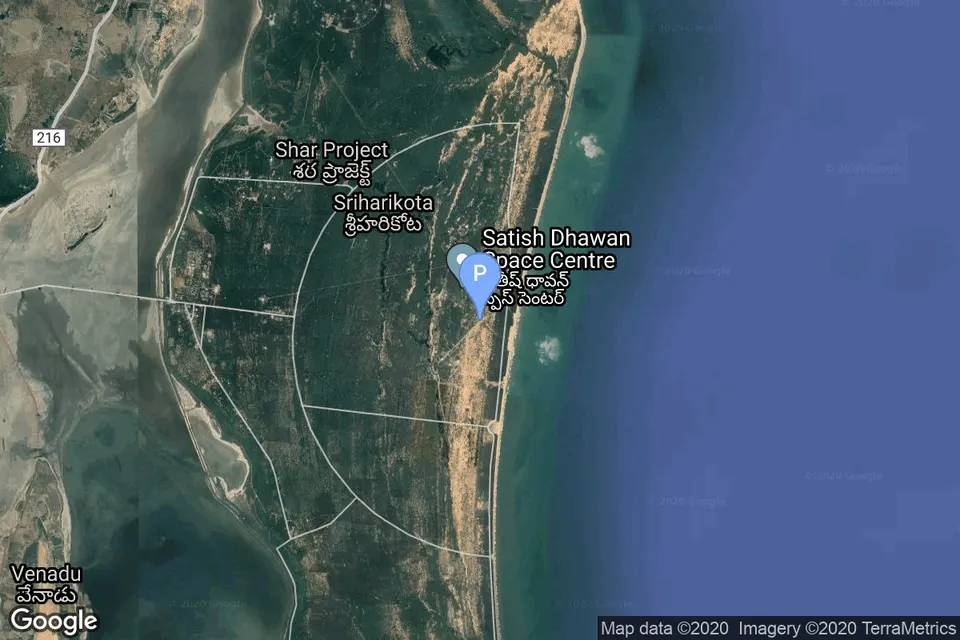
Satish Dhawan Space Centre Second Launch Pad, Satish Dhawan Space Centre, India
30th launch from Satish Dhawan Space Centre Second Launch Pad, 2nd this year · 100th from Satish Dhawan Space Centre, India
Local pad time at liftoff: Jul 30, 5:40 PM GMT+5:30, in daylight
33 launches from this pad · 105 from Satish Dhawan Space Centre, India
182 days after the previous launch from this pad
All launches from Satish Dhawan Space Centre, IndiaOpen in maps
Updates
Satellite in operation.
Show 9 earlier updates
Spacecraft separation.
Cosmic_Penguin · 7/30/2025 · source
Liftoff.
Cosmic_Penguin · 7/30/2025 · source
Official Webcast by NASA has started
LL2 · 7/30/2025 · source
GO for launch.
Cosmic_Penguin · 7/21/2025 · source
NET July 30.
Cosmic_Penguin · 7/4/2025 · source
NET July 16.
Cosmic_Penguin · 6/19/2025 · source
NET July 5.
Cosmic_Penguin · 6/4/2025 · source
NET June 18 per NOTAMs, TBC.
Cosmic_Penguin · 5/22/2025 · source
NET June.
Cosmic_Penguin · 4/18/2025 · source
Questions
When did NISAR (NASA-ISRO Synthetic Aperture Radar) launch?
NISAR (NASA-ISRO Synthetic Aperture Radar) launched on July 30, 2025 at 12:10 UTC.
Where can I watch NISAR (NASA-ISRO Synthetic Aperture Radar)?
Coverage: NISAR Launch; GSLV-F16 Launch with NASA-ISRO NISAR Earth Observation Satellite; NISAR Launch. Watch the replay
What rocket launched NISAR (NASA-ISRO Synthetic Aperture Radar)?
GSLV Mk. II, flown by Indian Space Research Organization. GSLV Mk. II spec sheet
Where did NISAR (NASA-ISRO Synthetic Aperture Radar) launch from?
Satish Dhawan Space Centre Second Launch Pad, Satish Dhawan Space Centre, India. Liftoff was Jul 30, 5:40 PM GMT+5:30 local time at the pad.
What orbit did NISAR (NASA-ISRO Synthetic Aperture Radar) reach?
NISAR, one of 2 catalogued objects, reached a 741 × 757 km orbit inclined 98.4°.
How many satellites did NISAR (NASA-ISRO Synthetic Aperture Radar) launch?
1 payload from this launch is catalogued, still in orbit (Data from J. McDowell, planet4589.org).