![[AUTO] Space Shuttle - image](/media?u=https%3A%2F%2Fthespacedevs-prod.nyc3.digitaloceanspaces.com%2Fmedia%2Fimages%2Fspace_shuttle_image_20230422074810.jpeg&w=1600)
Lockheed Space Operations CompanySpace ShuttleLaunch Complex 39B, Kennedy Space Center, FL, USA
STS-31 (Hubble)
Launched
April 24, 1990

Summary
STS-31 (Hubble) launched on a Lockheed Space Operations Company Space Shuttle from Launch Complex 39B, Kennedy Space Center, FL, USA on April 24, 1990. It was Lockheed Space Operations Company's 26th launch, 3rd this year and humanity's 3,515th orbital launch attempt. It was the 35th Space Shuttle flight and the 3rd this year. The payload was bound for low Earth orbit (LEO). Discovery (STS-31), one of 4 catalogued objects, reached a 63 × 618 km orbit inclined 28.5°. 5 crew members flew: Steven Hawley, Bruce McCandless II, Loren Shriver, Kathryn D. Sullivan and Charles Bolden. The spacecraft was Space Shuttle Discovery (OV-103). 4 objects from this launch are catalogued, 2 of them payloads.
- Watch
- STS-31 launch & landing (4-24-90)3210andLiftoff
- Vehicle
- Space Shuttle · Lockheed Space Operations CompanyNASA Large Strategic Science Missions, Space Shuttle
- Booster
- No booster details on record.
- Mission
- Astrophysics · Low Earth Orbit (LEO)
- Milestone
- 35th Space Shuttle flight · 3rd this yearLockheed Space Operations Company's 26th launch3rd this yearhumanity's 3,515th orbital launch attempt39th orbital launch attempt this year
Crew
 Steven HawleyMission Specialist · NASA · age 38 · 3rd flight
 Bruce McCandless IIMission Specialist · NASA · age 52 · 2nd flight
 Loren ShriverCommander · NASA · age 45 · 2nd flight
 Kathryn D. SullivanMission Specialist · NASA · age 38 · 2nd flight
 Charles BoldenPilot · NASA · age 43 · 2nd flight
Spacecraft
Space Shuttle Discovery (OV-103)
Space Shuttle Discovery (Orbiter Vehicle Designation: OV-103) is one of the orbiters from NASA's Space Shuttle program and the third of five fully operational orbiters to be built. Its first mission, STS-41-D, flew from August 30 to September 5, 1984. Over 27 years of service it launched and landed 39 times, gathering more spaceflights than any other spacecraft to date. Discovery became the third operational orbiter to enter service, preceded by Columbia and Challenger. It embarked on its last mission, STS-133, on February 24, 2011 and touched down for the final time at Kennedy Space Center on March 9, having spent a cumulative total of almost a full year in space. Discovery performed both research and International Space Station (ISS) assembly missions. It also carried the Hubble Space Telescope into orbit. Discovery was the first operational shuttle to be retired, followed by Endeavour and then Atlantis.
- Destination: Low Earth Orbit
- Mission length: 5 days 1 hour
Space Shuttle Discovery successfully landed at Edwards Air Force Base after this mission.
Flight preview
Orbit: as tracked
Discovery (STS-31) · NORAD 20579 · 1990-037 · Space-Track · tracking 1 of 4 objects
Show the numbers for orbit elements
- Object
- STS 31
- Object ID
- 1990-037A
- Epoch
- 1990-04-24 12:17:59 UTC
- Mean motion
- 15.78881927 rev/day
- Eccentricity
- 0.0413694
- Inclination
- 28.4691°
- Ascending node
- 230.9966°
- Arg. of perigee
- 64.3559°
- Mean anomaly
- 299.9193°
- Element set
- 999
- Rev at epoch
- 0
- B*
- 8.0384e-10
Perigee, apogee and period are Kepler figures from the catalogued mean elements, not a propagated state. Published orbit: LEO. Ascent drawn from padside's representative profile.
Catalogued objects
4 catalogued: 2 payloads, 1 debris, 1 component
- Discovery (STS-31) · NORAD 20579 · landed April 29, 1990
- Hubble Space Telescope · NORAD 20580
Data from J. McDowell, planet4589.org
About this launch
STS-31 was the thirty-fifth mission of the space shuttle program. Discovery's tenth mission deployed the Hubble Space Telescope.
News
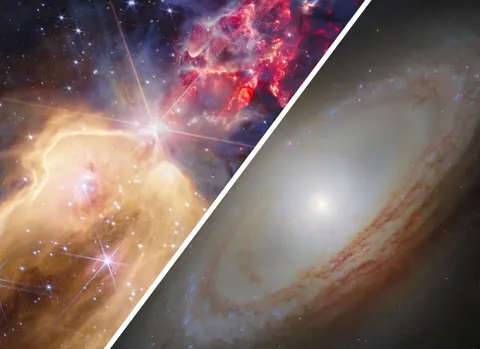 Webb and Hubble observe stellar nurseries, galaxies, and gravitational lensing in new imagesTeams using the James Webb Space Telescope and the Hubble Space Telescope — both jointly…
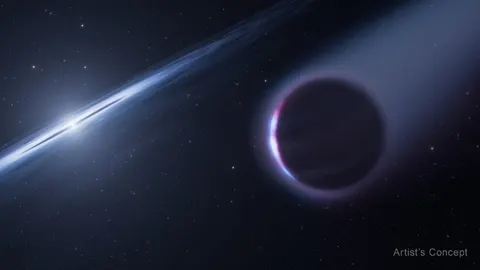 Astronomers Solve Cosmic Cold Case with NASA Hubble DataDiligent sleuthing by astronomers uncovered a surprising chemical clue that indicates the white dwarf star HS 0209+0832 may host a second-generation planet. This artist’s concept released on Oct. 5, 2026, depicts that possible explanation. The white dwarf is the “dead” core of a star that burned through all of its nuclear fuel and lost its outer […]
 Suspected Second-generation Planet Solves NASA Hubble Cold CaseNew analysis of archival Hubble data points to the possibility of “dead” white dwarf stars hosting second-generation planetary systems.
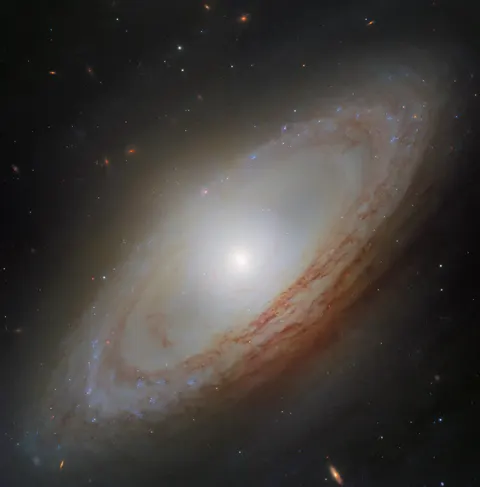 Hubble Spots Chaotic Secret in GalaxyA chaotic secret hides within this seemingly serene image of spiral galaxy NGC 4698 taken by NASA’s Hubble Space Telescope and released on Sept. 18, 2026. As a spiral galaxy like our own Milky Way galaxy, NGC 4698 has spiral arms that curl around within a thin disk of stars, gas, and dust. These arms […]
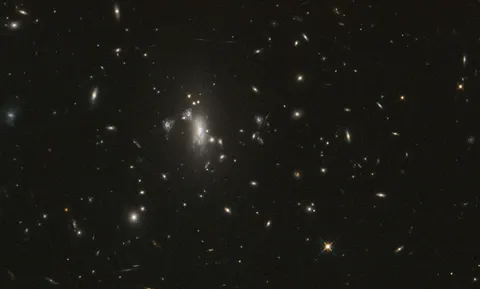 NASA’s Hubble Telescope Reaches Milestone, Looks for Elusive SupernovaNASA’s Hubble Space Telescope captured this image of massive galaxy cluster MACS J0417 (left of center) on Sept. 19, 2026. This galaxy cluster acts as a gravitational lens, bending and magnifying light from objects far behind it. Supernova Athena, discovered by NASA’s James Webb Space Telescope in 2025, is predicted to reappear between now and […]
 NASA’s Hubble Seeks Lensed Supernova, Marks 200,000 OrbitsNASA’s Hubble Space Telescope completed its 200,000th orbit around Earth on Sept. 19, marking another new milestone for an observatory that continues to transform our understanding of the universe. Hubble has traveled more than 5 billion miles around Earth over its 36-year lifetime, exceeding 1.7 million total observations. An observation completed on the day of […]
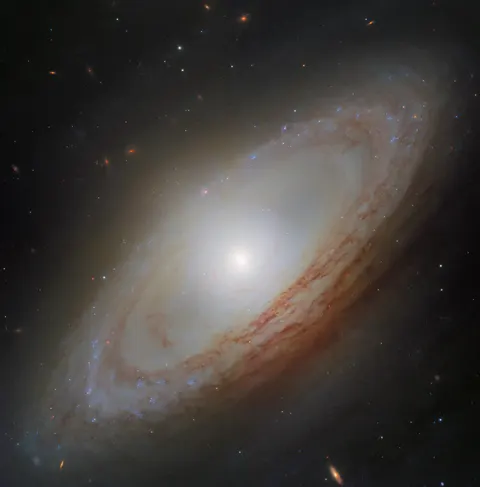 NASA’s Hubble Spots an Out-of-Sync GalaxyThough the spiral galaxy in this new image from the NASA/ESA Hubble Space Telescope seems serene, it hides a chaotic secret. This galaxy is NGC 4698, and it lies about 55 million light-years away in the constellation Virgo. It’s one of over a thousand galaxies in the Virgo Cluster, the nearest large cluster of galaxies bound together by […]
 A galaxy spinning out of syncThough the spiral galaxy in this new image by the NASA/ESA Hubble Space Telescope seems serene, it hides a chaotic secret. This galaxy is NGC 4698, and it lies about 55 million light-years away in the constellation Virgo. It’s one of over one thousand galaxies in the Virgo Cluster, the nearest large cluster of galaxies bound together by gravity.
Pad
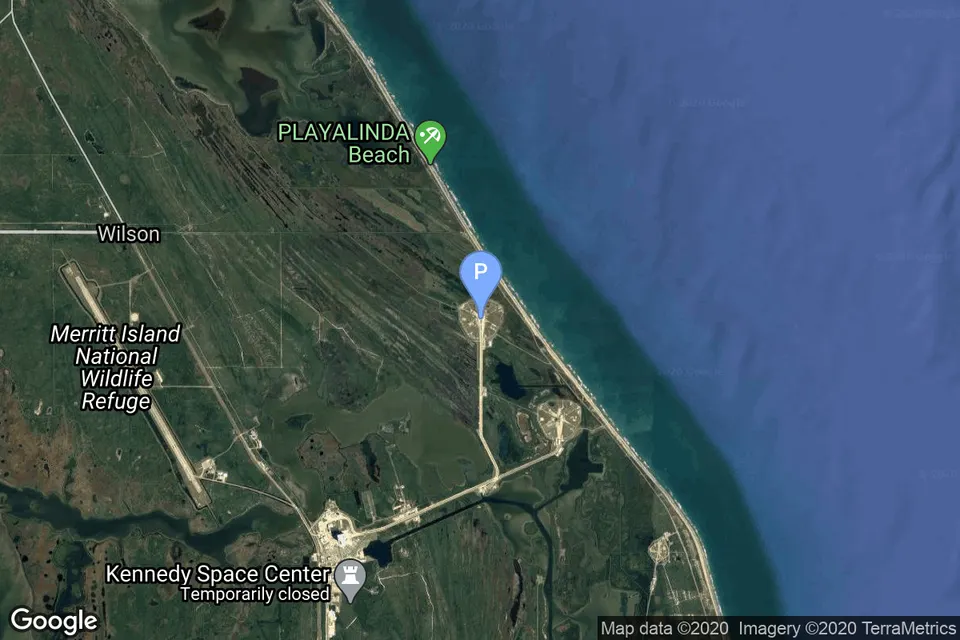
Launch Complex 39B, Kennedy Space Center, FL, USA
14th launch from Launch Complex 39B, 1st this year · 52nd from Kennedy Space Center, FL, USA
59 launches from this pad · 283 from Kennedy Space Center, FL, USA
152 days after the previous launch from this pad
Questions
When did STS-31 (Hubble) launch?
STS-31 (Hubble) launched on April 24, 1990. The time is known to the hour, not the minute.
Where can I watch STS-31 (Hubble)?
Coverage: STS-31 launch & landing (4-24-90). Watch the replay
What rocket launched STS-31 (Hubble)?
Space Shuttle, flown by Lockheed Space Operations Company. Space Shuttle spec sheet
Where did STS-31 (Hubble) launch from?
Launch Complex 39B, Kennedy Space Center, FL, USA.
What orbit did STS-31 (Hubble) reach?
Discovery (STS-31), one of 4 catalogued objects, reached a 63 × 618 km orbit inclined 28.5°.
How many satellites did STS-31 (Hubble) launch?
2 payloads from this launch are catalogued (Data from J. McDowell, planet4589.org).
Which program is STS-31 (Hubble) part of?
NASA Large Strategic Science Missions and Space Shuttle. About NASA Large Strategic Science Missions