
SpaceXFalcon 9 Block 5Space Launch Complex 4E, Vandenberg SFB, CA, USA
RADARSAT Constellation
Launched
June 12, 2019

Image: SpaceX
Summary
RADARSAT Constellation launched on a SpaceX Falcon 9 Block 5 from Space Launch Complex 4E, Vandenberg SFB, CA, USA on June 12, 2019. It was SpaceX's 80th launch, 7th this year and humanity's 5,857th orbital launch attempt. It was the 16th Falcon 9 Block 5 flight and the 6th this year. Booster B1051 flew for the 2nd time and landed at Landing Zone 4. The payload was bound for Sun-Synchronous Orbit (SSO). RCM 1, one of 3 catalogued objects, reached a 594 × 611 km orbit inclined 97.8°. 3 objects from this launch are catalogued, all of them payloads.
- Watch
- Watch SpaceX launch RADARSAT on a Falcon 9!Space Launch Now
- RADARSAT Constellation MissionSpaceX
- Vehicle
- Falcon 9 Block 5 · SpaceX
- Booster
- B1051 · flight 2 · Return to Launch Site at Landing Zone 4 · landed35/35 landed here · 102 days after its previous flight, SpX-DM1 (Demonstration Mission 1)
- Mission
- Earth Science · Sun-Synchronous Orbit (SSO)
- Milestone
- 16th Falcon 9 Block 5 flight · 6th this yearSpaceX's 80th launch7th this yearhumanity's 5,857th orbital launch attempt37th orbital launch attempt this year
Webcast
Flight preview
Orbit: as tracked
RCM 1 · NORAD 44322 · 2019-033 · Space-Track · tracking 1 of 3 objects
Show the numbers for orbit elements
- Object
- TBA - TO BE ASSIGNED
- Object ID
- 2019-033A
- Epoch
- 2019-06-12 15:44:44 UTC
- Mean motion
- 14.90752181 rev/day
- Eccentricity
- 0.0012483
- Inclination
- 97.7638°
- Ascending node
- 170.8418°
- Arg. of perigee
- 255.8924°
- Mean anomaly
- 203.682°
- Element set
- 999
- Rev at epoch
- 0
- B*
- 0
Perigee, apogee and period are Kepler figures from the catalogued mean elements, not a propagated state. Published orbit: SSO. Ascent drawn from padside's representative profile. Booster return drawn from padside's representative arc.
Catalogued objects
3 catalogued: 3 payloads; 3 still in orbit
- RCM 1 · NORAD 44322 · in orbit
- RCM 2 · NORAD 44323 · in orbit
- RCM 3 · NORAD 44324 · in orbit
Data from J. McDowell, planet4589.org
About this launch
The Radarsat Constellation Mission is a follow-on project to RADARSAT-2 currently developed by MDA. The constellation will consist of a fleet of three spacecraft, and be both complementary and a follow-on to the upcoming deployment of the RADARSAT-2 mission. The primary purpose of the RCM is to provide C-Band data continuity for RADARSAT-2 users, as well as adding a new series of applications enabled through the constellation approach. The main uses of RCM are expected to be in the areas of: maritime surveillance (ship detection, ice monitoring, and oil spill detection), disaster management, ecosystem monitoring. The primary areas of interest are the landmass of Canada and its surrounding Arctic, Pacific and Atlantic maritime areas. The images and derived information are required to be provided to Canadian government users at frequent area coverage rates. Contrary to the earlier RadarSat missions, the imagery will not be available commercially. The spacecraft Payload will consist of a Synthetic Aperture Radar (SAR) sensor integrated with an Automated Identification System (AIS). The SAR Payload concept is a 2-panel deployable SAR antenna of length approximately 7 meters.
Pad
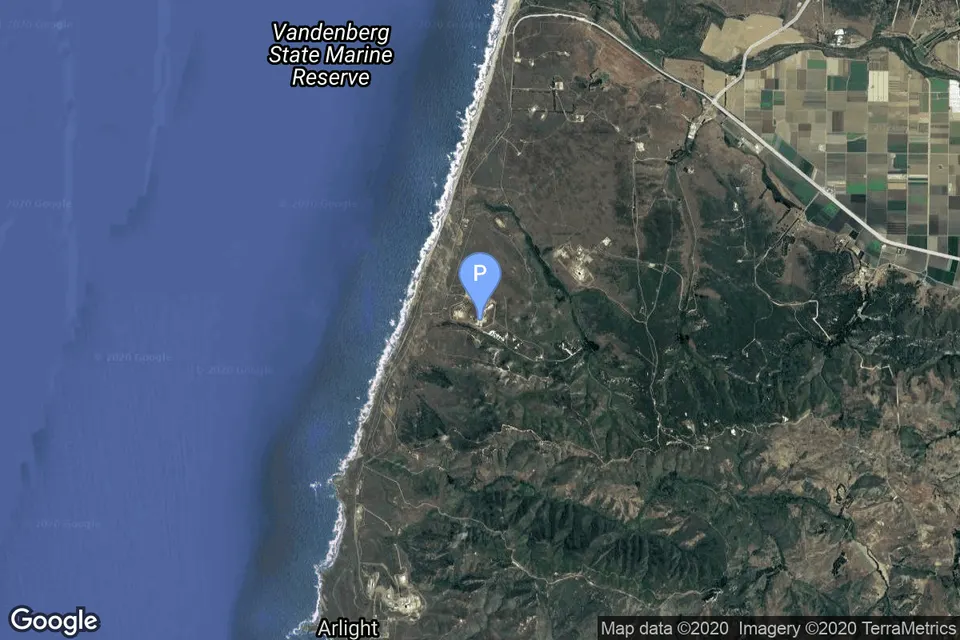
Space Launch Complex 4E, Vandenberg SFB, CA, USA
83rd launch from Space Launch Complex 4E, 2nd this year · 686th from Vandenberg SFB, CA, USA
303 launches from this pad · 919 from Vandenberg SFB, CA, USA
151 days after the previous launch from this pad
Questions
When did RADARSAT Constellation launch?
RADARSAT Constellation launched on June 12, 2019. The time is known to the hour, not the minute.
Where can I watch RADARSAT Constellation?
Coverage: Watch SpaceX launch RADARSAT on a Falcon 9!; RADARSAT Constellation Mission. Watch the replay
What rocket launched RADARSAT Constellation?
Falcon 9 Block 5, flown by SpaceX. Falcon 9 Block 5 spec sheet
Where did RADARSAT Constellation launch from?
Space Launch Complex 4E, Vandenberg SFB, CA, USA.
Did the booster land?
Booster B1051 flew for the 2nd time and landed at Landing Zone 4.
What orbit did RADARSAT Constellation reach?
RCM 1, one of 3 catalogued objects, reached a 594 × 611 km orbit inclined 97.8°.
How many satellites did RADARSAT Constellation launch?
3 payloads from this launch are catalogued, 3 of them still in orbit (Data from J. McDowell, planet4589.org).