
SpaceXFalcon 9 Block 5Launch Complex 39A, Kennedy Space Center, FL, USA
IMAP & others
Launched
September 24, 2025 · 11:30 UTC

Image: SpaceX
Summary
IMAP & others launched on a SpaceX Falcon 9 Block 5 from Launch Complex 39A, Kennedy Space Center, FL, USA on September 24, 2025 at 11:30 UTC. The launch window ran from 11:30 to 11:30 UTC. It was SpaceX's 574th launch, 125th this year and humanity's 7,070th orbital launch attempt. It was the 482nd Falcon 9 Block 5 flight and the 121st this year. Booster B1096 flew for the 2nd time and landed at Just Read the Instructions. The payload was bound for Heliocentric L1 (L1-point). IMAP, one of 4 catalogued objects, reached a 190 × 1,221,463 km orbit inclined 28.4°. 4 objects from this launch are catalogued, 3 of them payloads.
- Watch
- Three New Missions Launch to Track Space WeatherNASA
- SpaceX IMAP & othersThe Space Devs
- IMAP MissionSpaceX
- Vehicle
- Falcon 9 Block 5 · SpaceX
- Booster
- B1096 · flight 2 · Autonomous Spaceport Drone Ship at Just Read the Instructions · landed156/157 landed here · 70 days after its previous flight, Amazon Leo (KF-01) · 550 km downrange
- Mission
- Heliophysics · Heliocentric L1 (L1-point)
- Milestone
- 482nd Falcon 9 Block 5 flight · 121st this yearSpaceX's 574th launch125th this yearhumanity's 7,070th orbital launch attempt221st orbital launch attempt this year
Webcast
Flight preview
Simulate in Flight ClubOrbit: as tracked
IMAP · NORAD 65725 · 2025-215 · Space-Track · tracking 1 of 4 objects
Show the numbers for orbit elements
- Object
- IMAP
- Object ID
- 2025-215A
- Epoch
- 2025-09-24 12:44:06 UTC
- Mean motion
- 0.01790468 rev/day
- Eccentricity
- 0.98937
- Inclination
- 28.38°
- Ascending node
- 11.9°
- Arg. of perigee
- 3.55°
- Mean anomaly
- 0.0022°
- Element set
- 999
- Rev at epoch
- 1
- B*
- 0
Perigee, apogee and period are Kepler figures from the catalogued mean elements, not a propagated state. Published orbit: L1-point. Ascent drawn from padside's representative profile. Booster return drawn from padside's representative arc.
Flight timeline
- T−38MGO for Prop Load
- T−35MProp Load
- T−35MStage 1 LOX Load
- T−16MStage 2 LOX Load
- T−7MEngine Chill
- T−1MStartup
- T−1MTank Press
- T−45SGO for Launch
- T−3SIgnition
- T−0Liftoff
- T+1M12SMax-Q
- T+2M29SMECO
- T+2M32SStage 2 Separation
- T+2M40SSES-1
- T+3M12SFairing Separation
- T+6M37SEntry Burn Startup
- T+7M7SEntry Burn Shutdown
- T+7M52SSECO-1
- T+8M20SStage 1 Landing Burn
- T+8M45SStage 1 Landing
- T+1H12M28SSES-2
- T+1H13M30SSECO-2
- T+1H23M51SPayload Separation
- T+1H30M26SPayload Separation
- T+1H36M46SPayload Separation
Catalogued objects
4 catalogued: 3 payloads, 1 rocket stage
- IMAP · NORAD 65725 · left Earth orbit September 25, 2025
- SWFO-L1 · NORAD 65726 · left Earth orbit September 25, 2025
- Carruthers Geocorona Obs. · NORAD 65727 · left Earth orbit September 25, 2025
Falcon 9-518 Stage 2 · left Earth orbit September 25, 2025
Data from J. McDowell, planet4589.org
About this launch
IMAP (Interstellar Mapping and Acceleration Probe) is a NASA mission to study interactions between solar wind and the local interstellar medium. Carrying a suite of 10 scientific instruments, IMAP is able to investigate how particles are accelerated, determine their composition, as well as help to advance space weather forecasting models. The IMAP launch also includes the space weather satellite SWFO-L1 (Space Weather Follow-On - L1) for NOAA and the GLIDE (Global Lyman-alpha Imagers of the Dynamic Exosphere/Carruthers Geocorona Observatory) mission to study far ultraviolet emission in the Earth's exosphere.
Pad
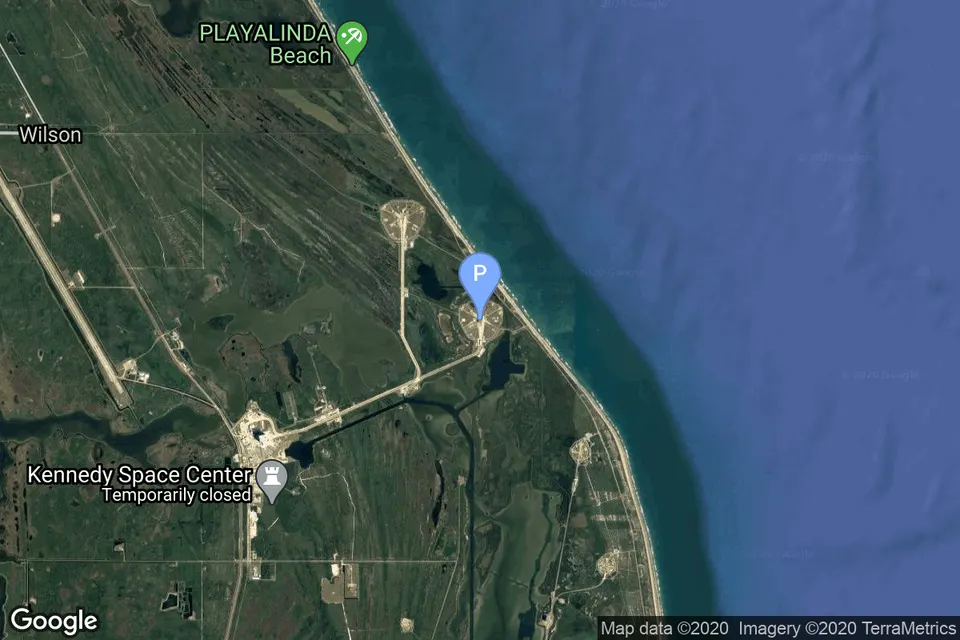
Launch Complex 39A, Kennedy Space Center, FL, USA
215th launch from Launch Complex 39A, 21st this year · 273rd from Kennedy Space Center, FL, USA
Local pad time at liftoff: Sep 24, 7:30 AM EDT, in daylight
224 launches from this pad · 283 from Kennedy Space Center, FL, USA
18 days after the previous launch from this pad
Updates
Launch success with acquisition of signal from all 3 spacecraft.
Show 9 earlier updates
Liftoff.
Cosmic_Penguin · 9/24/2025 · source
Official Webcast by NASA has started
LL2 · 9/24/2025 · source
Now targeting Sep 24 at 11:30:50 UTC
hitura-nobad · 9/24/2025 · source
Weather is 90% favorable for launch.
Cosmic_Penguin · 9/23/2025 · source
Delayed to September 24.
Cosmic_Penguin · 9/22/2025 · source
Weather is 75% favorable for launch.
Cosmic_Penguin · 9/21/2025 · source
Weather is 80% favorable for launch.
Cosmic_Penguin · 9/20/2025 · source
Tweaked T-0.
Cosmic_Penguin · 9/13/2025 · source
Setting GO.
Cosmic_Penguin · 9/8/2025 · source
Questions
When did IMAP & others launch?
IMAP & others launched on September 24, 2025 at 11:30 UTC. The launch window ran from 11:30 to 11:30 UTC.
Where can I watch IMAP & others?
Coverage: Three New Missions Launch to Track Space Weather; SpaceX IMAP & others; IMAP Mission. Watch the replay
What rocket launched IMAP & others?
Falcon 9 Block 5, flown by SpaceX. Falcon 9 Block 5 spec sheet
Where did IMAP & others launch from?
Launch Complex 39A, Kennedy Space Center, FL, USA. Liftoff was Sep 24, 7:30 AM EDT local time at the pad.
Did the booster land?
Booster B1096 flew for the 2nd time and landed at Just Read the Instructions.
What orbit did IMAP & others reach?
IMAP, one of 4 catalogued objects, reached a 190 × 1,221,463 km orbit inclined 28.4°.
How many satellites did IMAP & others launch?
3 payloads from this launch are catalogued (Data from J. McDowell, planet4589.org).