
SpaceXFalcon HeavyLaunch Complex 39A, Kennedy Space Center, FL, USA
GOES-U
Launched
June 25, 2024 · 21:26 UTC

Image: SpaceX
Summary
GOES-U launched on a SpaceX Falcon Heavy from Launch Complex 39A, Kennedy Space Center, FL, USA on June 25, 2024 at 21:26 UTC. The launch window ran from 21:16 to 23:16 UTC. It was SpaceX's 378th launch, 67th this year and humanity's 6,711th orbital launch attempt. It was the 10th Falcon Heavy flight and the 1st this year. Booster B1087 flew for the 1st time and was expended. Booster B1072 flew for the 1st time and landed at Landing Zone 1. Booster B1086 flew for the 1st time and landed at Landing Zone 2. The payload was bound for Geostationary Transfer Orbit (GTO). GOES 19, one of 2 catalogued objects, reached a 16,017 × 35,247 km orbit inclined 4.3°. 2 objects from this launch are catalogued, one of them a payload.
- Watch
- Booster
- Mission
- Earth Science · Geostationary Transfer Orbit (GTO)for NASA
- Milestone
- 10th Falcon Heavy flight · 1st this yearSpaceX's 378th launch67th this yearhumanity's 6,711th orbital launch attempt122nd orbital launch attempt this year
Webcast
Flight preview
Simulate in Flight ClubOrbit: as tracked
GOES 19 · NORAD 60133 · 2024-119 · Space-Track · tracking 1 of 2 objects
Show the numbers for orbit elements
- Object
- TBA - TO BE ASSIGNED
- Object ID
- 2024-119A
- Epoch
- 2024-06-26 11:02:49 UTC
- Mean motion
- 1.51639569 rev/day
- Eccentricity
- 0.3004423
- Inclination
- 4.3467°
- Ascending node
- 95.2357°
- Arg. of perigee
- 179.9845°
- Mean anomaly
- 331.4193°
- Element set
- 999
- Rev at epoch
- 3
- B*
- 0
Perigee, apogee and period are Kepler figures from the catalogued mean elements, not a propagated state. Published orbit: GTO.
Flight timeline
- T−53MGO for Prop Load
- T−50MStage 1 Propellant Load
- T−45MStage 1 LOX Load
- T−35MStage 2 Propellant Load
- T−18M30SStage 2 LOX Load
- T−7MEngine Chill
- T−59SStartup
- T−45SGO for Launch
- T−20STank Press
- T−6SIgnition
- T−0Liftoff
- T+1M11SMax-Q
- T+2M25SSBECO
- T+2M28SBoosters Separation
- T+2M44SBoosters Boostback Burn Startup
- T+3M53SBoosters Boostback Burn Shutdown
- T+3M56SMECO
- T+3M59SStage 2 Separation
- T+4M6SSES-1
- T+4M24SFairing Separation
- T+6M36SBoosters Entry Burn Startup
- T+6M51SBoosters Entry Burn Shutdown
- T+7M53SBoosters Landing Burn
- T+8M11SBoosters Landing
- T+8M23SSECO-1
- T+26M19SSES-2
- T+27M46SSECO-2
- T+4H21M18SSES-3
- T+4H21M51SSECO-3
- T+4H30M2SPayload Separation
Catalogued objects
2 catalogued: 1 payload, 1 rocket stage; 2 still in orbit
- GOES 19 · NORAD 60133 · in orbit
Falcon Heavy-010 Stage 2 · in orbit
Data from J. McDowell, planet4589.org
About this launch
The Geostationary Operational Environmental Satellite-U (GOES-U) is the fourth of the next generation of geostationary weather satellites, known as the GOES-R series. The four satellites of the series provide advanced imaging with increased spatial resolution and faster coverage for more accurate forecasts, real-time mapping of lightning activity, and improved monitoring of solar activity. Once GOES-U reaches orbit, it will be renamed GOES-19.
Pad
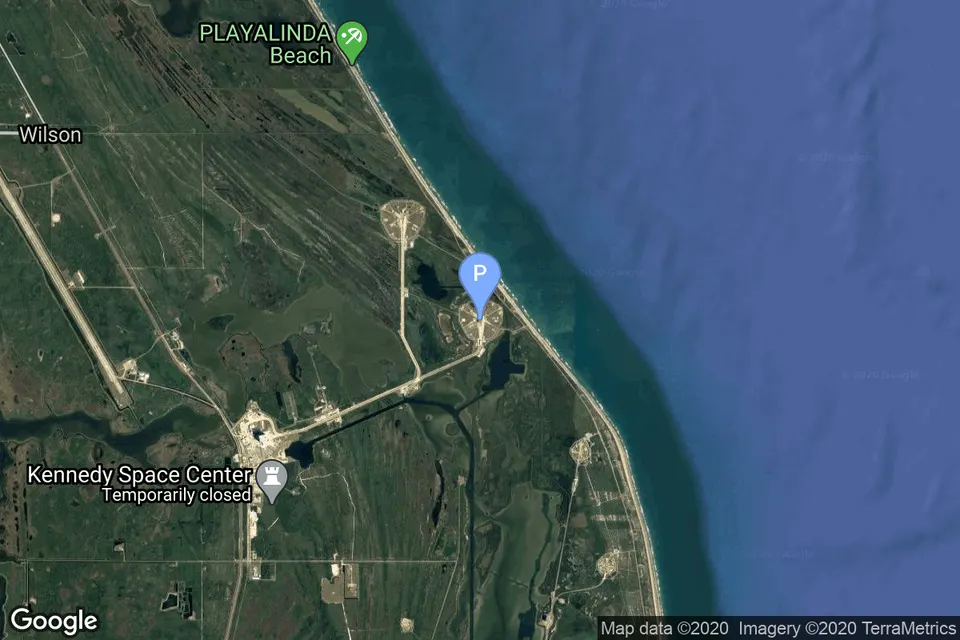
Launch Complex 39A, Kennedy Space Center, FL, USA
181st launch from Launch Complex 39A, 13th this year · 239th from Kennedy Space Center, FL, USA
Local pad time at liftoff: Jun 25, 5:26 PM EDT, in daylight
224 launches from this pad · 283 from Kennedy Space Center, FL, USA
32 days after the previous launch from this pad
Updates
Launch success with spacecraft solar arrays deployed.
Show 9 earlier updates
Spacecraft separation.
Cosmic_Penguin · 6/26/2024 · source
Liftoff.
Cosmic_Penguin · 6/25/2024 · source
Weather 60%
Nosu · 6/25/2024 · source
Delayed by 10 minutes
Nosu · 6/25/2024 · source
Official Webcast by NASA has started
LL2 · 6/25/2024 · source
Weather 30%
Nosu · 6/22/2024 · source
Updated launch window.
Cosmic_Penguin · 5/9/2024 · source
NET June 25.
Cosmic_Penguin · 3/26/2024 · source
Delayed to NET May 2024.
Cosmic_Penguin · 2/27/2024 · source
Questions
When did GOES-U launch?
GOES-U launched on June 25, 2024 at 21:26 UTC. The launch window ran from 21:16 to 23:16 UTC.
Where can I watch GOES-U?
Coverage: Geostationary Operational Environmental Satellite-U (GOES-U) Launch; Watch live: SpaceX Falcon Heavy launches GOES-U weather satellite from NASA's Kennedy Space Center; SpaceX Falcon Heavy Launches GOES-U. Watch the replay
What rocket launched GOES-U?
Falcon Heavy, flown by SpaceX. Falcon Heavy spec sheet
Where did GOES-U launch from?
Launch Complex 39A, Kennedy Space Center, FL, USA. Liftoff was Jun 25, 5:26 PM EDT local time at the pad.
Did the booster land?
Booster B1087 flew for the 1st time and was expended. Booster B1072 flew for the 1st time and landed at Landing Zone 1. Booster B1086 flew for the 1st time and landed at Landing Zone 2.
What orbit did GOES-U reach?
GOES 19, one of 2 catalogued objects, reached a 16,017 × 35,247 km orbit inclined 4.3°.
How many satellites did GOES-U launch?
1 payload from this launch is catalogued, still in orbit (Data from J. McDowell, planet4589.org).
Which program is GOES-U part of?
Geostationary Operational Environmental Satellite. About Geostationary Operational Environmental Satellite