
National Aeronautics and Space AdministrationSpace Launch System Block 1Launch Complex 39B, Kennedy Space Center, FL, USA
Artemis II
Launched
April 1, 2026 · 22:35 UTC

Image: NASA/Joel Kowsky
Summary
Artemis II launched on a National Aeronautics and Space Administration Space Launch System Block 1 from Launch Complex 39B, Kennedy Space Center, FL, USA on April 1, 2026 at 22:35 UTC. The launch window ran from 22:24 to 00:24 UTC. It was National Aeronautics and Space Administration's 142nd launch, 1st this year and humanity's 7,246th orbital launch attempt. It was the 2nd Space Launch System Block 1 flight and the 1st this year. The payload was bound for Lunar flyby (Lunar flyby). Artemis II, one of 5 catalogued objects, reached a 32 × 2,230 km orbit inclined 28.5°. 4 crew members flew: Jeremy Hansen, Gregory R. Wiseman, Victor J. Glover and Christina Koch. The spacecraft was Orion Integrity (003). 5 objects from this launch are catalogued, 4 of them payloads.
- Watch
- Booster
- No booster details on record.
- Mission
- Human Exploration · Lunar flyby (Lunar flyby)for CSA, NASA
- Milestone
- 2nd Space Launch System Block 1 flight · 1st this yearNational Aeronautics and Space Administration's 142nd launch1st this yearhumanity's 7,246th orbital launch attempt73rd orbital launch attempt this year
Crew
 Jeremy HansenMission Specialist · CSA · age 50 · first flight
 Gregory R. WisemanSpacecraft Commander · NASA · age 50 · 2nd flight
 Victor J. GloverPilot · NASA · age 49 · 2nd flight
 Christina KochMission Specialist · NASA · age 47 · 2nd flight
Spacecraft
Orion Integrity (003)
Orion spacecraft used for Artemis 2.
- Destination: Circumlunar flyby
- Mission length: 9 days 1 hour
The Orion spacecraft Integrity has splashed down in the Pacific Ocean.
Webcast
Flight preview
Simulate in Flight ClubOrbit: as tracked
Artemis II · NORAD 68538 · 2026-069 · Space-Track · tracking 1 of 5 objects
Show the numbers for orbit elements
- Object
- TBA - TO BE ASSIGNED
- Object ID
- 2026-069A
- Epoch
- 2026-04-01 22:43:20 UTC
- Mean motion
- 13.3612228 rev/day
- Eccentricity
- 0.146527
- Inclination
- 28.5261°
- Ascending node
- 3.4072°
- Arg. of perigee
- 67.9232°
- Mean anomaly
- 24.0215°
- Element set
- 999
- Rev at epoch
- 0
- B*
- 0
Perigee, apogee and period are Kepler figures from the catalogued mean elements, not a propagated state. Published orbit: Lunar flyby. Ascent drawn from padside's representative profile.
Flight timeline
- -P2DT1H50MLaunch Team On Stations
- -P2DT1H40MCountdown Start
- -P2DT1H40MProp Load Preparations
- -P1DT21H30MOrion Power On
- -P1DT18H20MCore Stage Power On
- -P1DT18H10MICPS Power On
- -P1DT15H45MRS-25 Preparations
- -P1DT11H45MICPS Power Off
- -P1DT9H30MOrion Batteries Charging
- -P1DT7H30MCore Stage Batteries Charging
- T−20H15MICPS Power On
- T−15HPad Closeout
- T−14H15MRocket Cavity Inerting
- T−13H15MGLS Activation
- T−12H35MBuilt-In Hold
- T−10H50MGO for Prop Load
- T−10H50MOrion Cold Soak
- T−10H40MCore Stage LH2 Chill
- T−10H40MCore Stage LOX Transfer Chill
- T−10H25MCore Stage LOX Prop Chill
- T−9H55MCore Stage LH2 Slow Fill
- T−9H50MResume T-Clock
- T−9H40MCore Stage LOX Slow Fill
- T−9H30MCore Stage LOX Fast Fill
- T−9H25MCore Stage LH2 Fast Fill
- T−9H5MICPS LH2 Chill
- T−8H30MICPS LH2 Fast Fill
- T−8HCore Stage LH2 Topping
- T−7H55MCore Stage LH2 Replenish
- T−7H45MICPS LH2 Vent & Relief Test
- T−7H20MICPS LH2 Topping
- T−7H5MICPS LH2 Replenish
- T−6H40MOrion Comms On
- T−6H40MCore Stage LOX Topping
- T−6H40MICPS LOX Prop Chill
- T−6H30MICPS LOX Fast Fill
- T−6H10MCloseout Crew Assemble
- T−6H10MStage Pad Rescue
- T−6H5MCore Stage LOX Replenish
- T−6HWeather Check
- T−5H45MICPS LOX Vent & Relief Test
- T−5H30MICPS LOX Topping
- T−5H10MICPS LOX Replenish
- T−5H10MBuilt-In Hold
- T−5H10MAll Stages Replenish
- T−5H10MCloseout Crew To White Room
- T−4H40MFlight Crew To Pad
- T−4HOrion Boarding
- T−3H40MHatch Closure
- T−3H10MHatch Seal Checks
- T−2H20MHatch Closeouts
- T−1H40MLAS Hatch Closure
- T−1H10MTPS Scan
- T−50MPad Clear
- T−50MTest Director Briefing
- T−40MBuilt-In Hold
- T−25MOrion Comms Transition
- T−17MReady Poll
- T−15MVisors Down
- T−14MShort Purge
- T−10MTerminal Count
- T−8MCrew Access Arm Retract
- T−6MTank Press
- T−6MOrion Pyros Arm
- T−6MOrion Internal Power
- T−5M57SCore Stage LH2 Replenish End
- T−5M20SLAS Available
- T−4M40SLH2 High Flow Bleed Check
- T−4M30SFTS Arm
- T−4MCore Stage APU Start
- T−4MCore Stage LOX Replenish End
- T−3M30SICPS LOX Replenish End
- T−3M10SPurge Sequence 4
- T−2M2SICPS Internal Power
- T−2MBooster Internal Power
- T−1M30SCore Stage Internal Power
- T−1M20SICPS Terminal Count
- T−50SICPS LH2 Replenish End
- T−33SGO for Launch
- T−30SCore Stage Terminal Count
- T−12SHydrogen Burnoff Igniters
- T−10SCore Stage Engine Start
- T−6.36SIgnition
- T−0Liftoff
- T−0Booster Ignition
- T+9STower Clear
- T+56SSupersonic
- T+1M10SMax-Q
- T+2M8SSRB Separation
- T+3M18SLaunch Escape Jettison
- T+8M6SMECO
- T+8M18SStage 2 Separation
- T+8M28SICPS RL10 Nozzle Extension
- T+20MOrion Solar Arrays Deployment
- T+49MPerigee Raise Burn
- T+1H47M57SApogee Raise Burn
- T+3H24M15SOrion Separation
- T+4H35MProximity Operations End
- T+4H52MOrion Separation Burn
- T+5HICPS Disposal Burn
- T+5H4MCubeSats Deployment
- T+13H44MPerigee Raise Burn
- P1DT1H37MTranslunar Injection Burn
- P1DT23H25MOrbital Trajectory Correction Burn
- P2DT7MOrbital Trajectory Correction Burn
- P2DT2H5MCrew CPR Demo
- P2DT5H25MDSN Comms Test
- P3DT12MOrbital Trajectory Correction Burn
- P3DT3H40MLunar Flyby Imaging Plan Review
- P3DT5H45MLunar Flyby Imaging Plan Review
- P3DT20H30MSpacesuits Demo
- P4DT5H23MOrbital Trajectory Correction Burn
- P4DT6H59MOrion Enters Lunar SOI
- P4DT22HLunar Flyby
- P5DT1H23MLunar Closest Approach
- P5DT1H26MMax Distance To Earth
- P5DT19H47MOrion Exits Lunar SOI
- P5DT21H10MLunar Flyby Debrief
- P6DT4H23MOrbital Trajectory Correction Burn
- P7DT1H50MRadiation Shielding Demo
- P7DT4H20MManual Piloting Demo
- P7DT23H15MOrthostatic Intolerance Garment Test
- P8DT2H10MOrthostatic Intolerance Garment Test
- P8DT4H33MOrbital Trajectory Correction Burn
- P8DT20H33MOrbital Trajectory Correction Burn
- P8DT22H30MCrew Entry Preparations
- P9DT1H13MOrion Service Module Jettison
- P9DT1H16MOrion Raise Burn
- P9DT1H33MAtmospheric Entry
- P9DT1H46MOrion Splashdown
- P9DT1H53MOrion RCS Safing
- P9DT2H1MOrion Power Off
Catalogued objects
5 catalogued: 4 payloads, 1 rocket stage; 1 still in orbit
- Artemis II · NORAD 68538 · left Earth orbit April 3, 2026
- TACHELES · NORAD 68539 · re-entered April 3, 2026
- SWC-1 · NORAD 68540 · in orbit
- K-RadCube · NORAD 68541 · re-entered April 2, 2026
ICPS 02 · deorbited April 2, 2026
Data from J. McDowell, planet4589.org
About this launch
Artemis II is the first crewed mission as part of the Artemis program. Artemis II will send a crew of 4 - 3 Americans and 1 Canadian around the moon and return them back to Earth. The mission will test the core systems of NASA's Orion spacecraft including the critical life support system, among other systems which could not be tested during Artemis I due to the lack of crew onboard.
Official page: Artemis II: ’s First Crewed Lunar Flyby in 50 Years
News
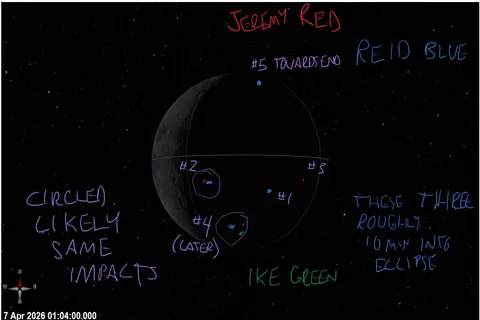 Artemis II Crew Moon Photo AnnotationsA visualization of a dark Moon eclipsing the Sun is marked with handwritten notes in this April 6, 2026, screenshot from an Artemis II crew member’s tablet. NASA astronauts Reid Wiseman (in blue) and Victor “Ike” Glover (in green) and CSA (Canadian Space Agency) Jeremy Hansen (in red) observed impact flashes and their locations, which […]
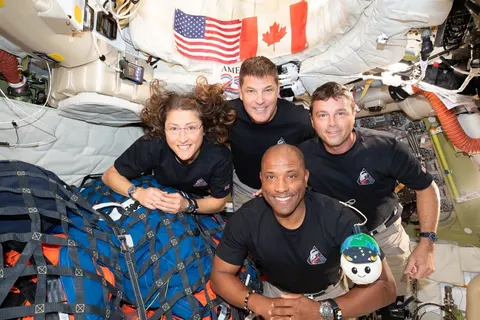 Meet NASA’s Artemis II Crew During Houston Public EventThe four astronauts of NASA’s Artemis II mission will participate in an event hosted by industry and community partners at the University of Houston to discuss their mission around the Moon aboard the Orion spacecraft. It will be the first event in Houston for the public following their lunar mission earlier this year and marks […]
 Artemis II Crew at NASA MarshallThe crew of NASA’s Artemis II mission – NASA astronauts Christina Koch, Victor Glover, and Reid Wiseman and CSA (Canadian Space Agency) astronaut Jeremy Hansen – visited Huntsville, Alabama, Sept. 1, 2026, where they met with the NASA workforce at NASA’s Marshall Space Flight Center. The event gave the crew an opportunity to share firsthand […]
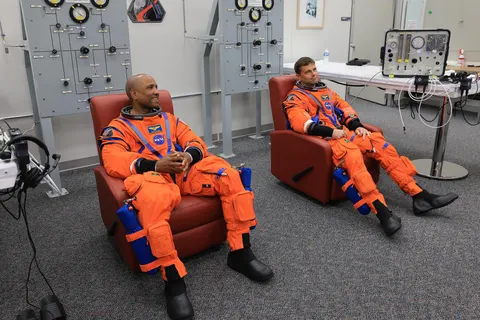 NASA Names Two Artemis II Astronauts to Emeritus ProgramFollowing their landmark Artemis II mission earlier this year, distinguished NASA astronauts Victor Glover and Reid Wiseman are transitioning in September to emeritus status at the agency’s Johnson Space Center in Houston. In an emeritus role, individuals with a high degree of technical and professional knowledge can continue to support the agency by donating their […]
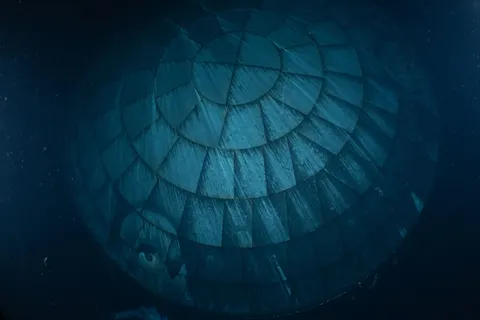 It turns out that Orion's much-maligned heat shield performed really wellIndependent safety officials also have high praise for changes by NASA leadership.
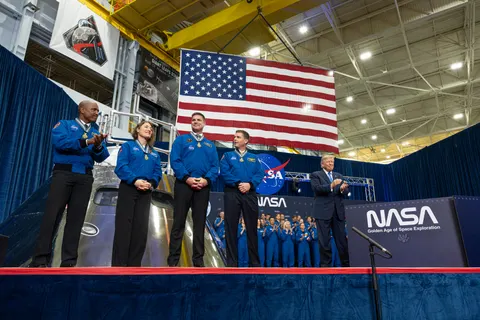 NASA’s Artemis II Crew Receives Congressional Space Medal of HonorFrom left to right: NASA astronauts Victor Glover and Christina Koch, CSA (Canadian Space Agency) astronaut Jeremy Hansen, and NASA astronaut Reid Wiseman receive the Congressional Space Medal of Honor from President Donald J. Trump on Aug. 28, 2026, for their service during the Artemis II mission. The Congressional Space Medal of Honor was authorized […]
 Trump Honors Artemis II Crew, Signs Executive Order to Establish a U.S. Space AcademyPresident Trump signed an Executive Order today during a ceremony honoring the Artemis II crew that will create a NASA-led U.S. Space Academy to “encourage and guide” students to pursue […]
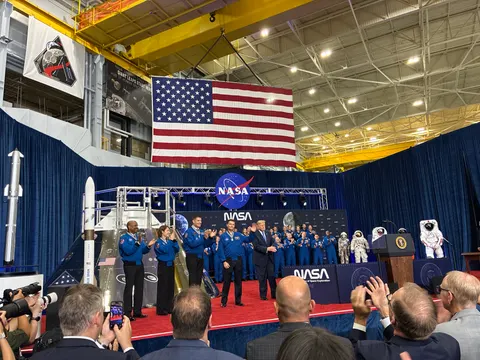 President Honors NASA’s Artemis II Crew with Highest US Space AwardPresident Donald J. Trump awarded NASA astronauts Reid Wiseman, Victor Glover, and Christina Koch, and CSA (Canadian Space Agency) astronaut Jeremy Hansen with the Congressional Space Medal of Honor Friday for their service during the Artemis II mission. He presented the awards during a ceremony at NASA’s Johnson Space Center in Houston, honoring the first […]
Pad
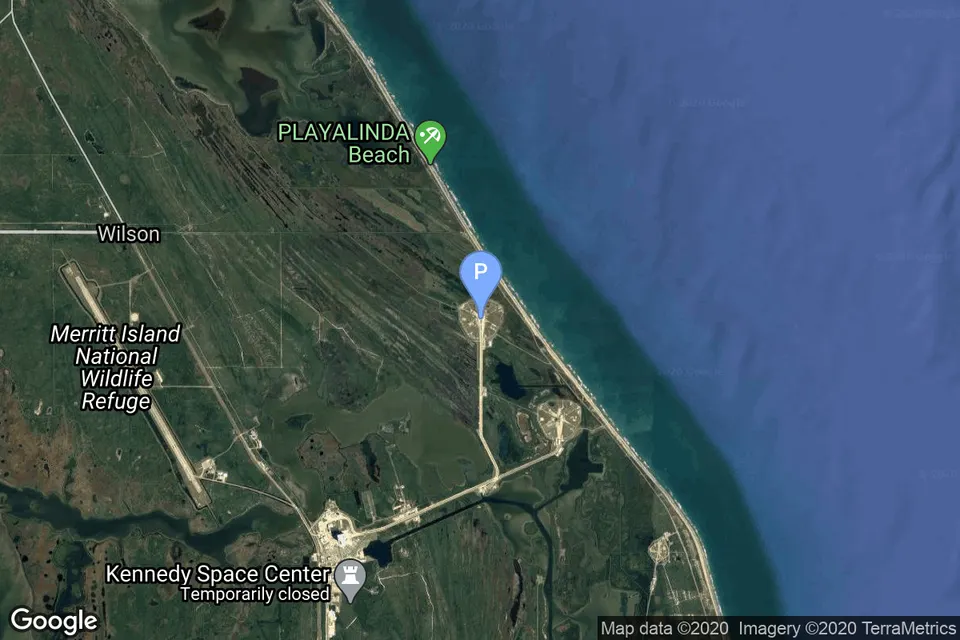
Launch Complex 39B, Kennedy Space Center, FL, USA
59th launch from Launch Complex 39B, 1st this year · 280th from Kennedy Space Center, FL, USA
Local pad time at liftoff: Apr 1, 6:35 PM EDT, in daylight
59 launches from this pad · 283 from Kennedy Space Center, FL, USA
about 3 years after the previous launch from this pad
Updates
Launch success with Orion separation.
Show 9 earlier updates
Liftoff.
Cosmic_Penguin · 4/1/2026 · source
New T-0.
Cosmic_Penguin · 4/1/2026 · source
Extending hold at T-10 minutes.
Cosmic_Penguin · 4/1/2026 · source
Updated launch weather.
Cosmic_Penguin · 4/1/2026 · source
Official Webcast by NASA has started
LL2 · 4/1/2026 · source
Updated launch weather.
Cosmic_Penguin · 4/1/2026 · source
T-0 is accurate to the second.
Cosmic_Penguin · 3/30/2026 · source
Updated launch weather, 80% GO.
Cosmic_Penguin · 3/29/2026 · source
Targeting April 1st.
Cosmic_Penguin · 3/12/2026 · source
Questions
When did Artemis II launch?
Artemis II launched on April 1, 2026 at 22:35 UTC. The launch window ran from 22:24 to 00:24 UTC.
Where can I watch Artemis II?
Coverage: NASA's Artemis II Crew Launches To The Moon (Official Broadcast); NASA’s Artemis II Crew Launches to the Moon (Official Broadcast). Watch the replay
What rocket launched Artemis II?
Space Launch System Block 1, flown by National Aeronautics and Space Administration. Space Launch System Block 1 spec sheet
Where did Artemis II launch from?
Launch Complex 39B, Kennedy Space Center, FL, USA. Liftoff was Apr 1, 6:35 PM EDT local time at the pad.
What orbit did Artemis II reach?
Artemis II, one of 5 catalogued objects, reached a 32 × 2,230 km orbit inclined 28.5°.
How many satellites did Artemis II launch?
4 payloads from this launch are catalogued, 1 of them still in orbit (Data from J. McDowell, planet4589.org).
Which program is Artemis II part of?
Artemis. About Artemis